
Institutional real estate decision-making is often shaped within specialized silos — LPs, GPs, developers, operators, and capital markets professionals each interpreting the market through their own lens. While effective within domains, this can lead to fragmented views of risk, value, and timing.
This roundtable brings together senior participants across the full investment lifecycle to enable peer-level, cross-functional exchange. Through a combination of cohort and mixed sessions, participants engage directly with the constraints, priorities, and decision frameworks of other key players across the ecosystem.
The result is a more integrated understanding of the forces driving risk and return, equipping participants with greater clarity, alignment, and confidence in their investment decisions.
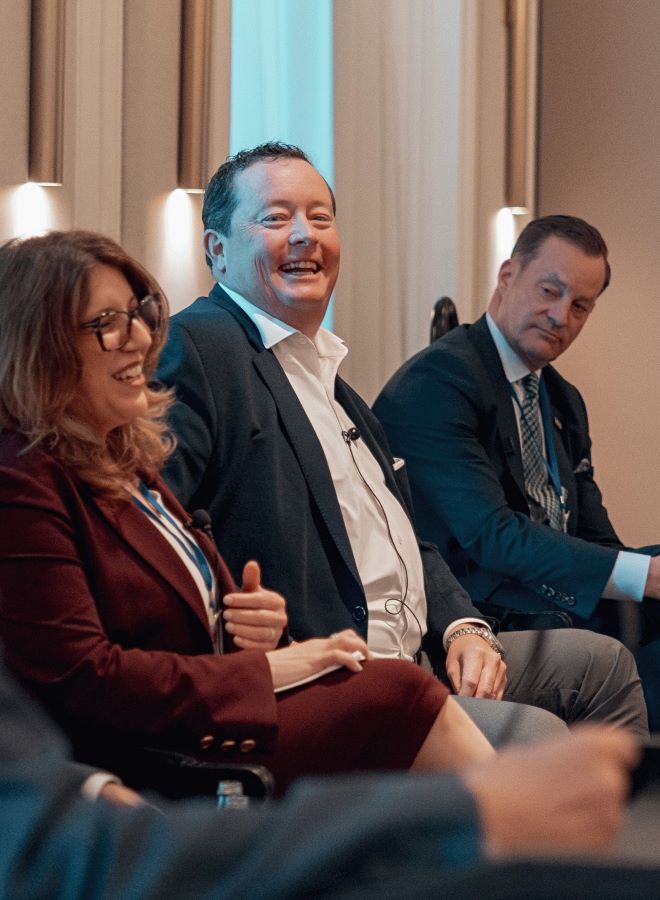
The goREAL Roundtable brings together 35–40 senior leaders from across the real estate private markets in a closed-door, invitation-only setting. Attendees include institutional investors, asset managers, developers, operators, and capital providers, ensuring a broad representation of the industry for peer-level exchange on investment decisions, portfolio strategy, and capital deployment.
Participants are active contributors throughout. Discussions alternate between expert cohort sessions and mixed-group roundtables, allowing perspectives to be tested and challenged across capital allocators, operators, and financing platforms in a focused, high-quality format. Institutional limited partners are fully integrated across mixed sessions, ensuring a consistent LP perspective and balanced discussion dynamic.
The four participant cohorts include:
— Institutional Capital & Portfolio Strategy (LPs)
— Investment & Asset Management (GPs)
— Financing & Capital Markets (Debt, Structuring, Liquidity)
— Development & Operating Platforms
Participants are carefully curated to ensure a balanced, senior-level composition across capital, investment, and operating perspectives.
*Participation is strictly by invitation only. Limited capacity.
*A preliminary agenda will be shared with all invited groups. Discussions are held under strict confidentiality, with no press, recording, or external attribution.
Group 1: Institutional Capital & Portfolio Strategy (LPs)
Focus on the quality, durability, and transparency of returns, with a strong emphasis on downside protection and portfolio-level risk exposure. Discussions also address liquidity visibility and manager alignment, reflecting LP priorities around capital preservation, governance, and re-investment decisions.
Group 2: Investment & Asset Management (GPs/Investors, Portfolio Managers)
Centered on deploying capital at attractive risk-adjusted returns while driving asset-level performance through disciplined execution. Key topics include financing risk, executing on investment strategy, and managing LP relationships in a more complex, performance-driven market.
Group 3: Financing & Capital Markets (Structuring, Debt, Recap, Liquidity)
Explore the evolving cost, availability, and structure of capital, with particular focus on debt strategy and refinancing risk. Topics include optimal leverage, covenant management, interest rate exposure, and balance sheet flexibility, alongside portfolio- and fund-level liquidity considerations. Participants examine how disciplined capital structuring and proactive financing decisions support execution certainty and resilient returns in a dynamic market environment.
Group 4: Development & Operating Platforms (Developers, Owners, Operators)
Focus on execution certainty across development and operations, from cost and timeline control to product-market fit and post-delivery performance. Discussions also explore platform scalability, operational efficiency, and capital management in an increasingly demanding environment.
Cohort Session
Participants break into expert cohorts to define how structural (not cyclical) changes are reshaping their segment. The objective is to surface baseline convictions, capital direction, and perceived mispricings that will be tested throughout the day.
Group 1 | Institutional Capital & Portfolio Strategy (LPs)
LPs are redefining real estate’s role within multi-asset portfolios in an environment shaped by higher rates, liquidity constraints, and increased dispersion in manager performance. Allocation discipline is shifting toward selectivity, governance, and risk-adjusted capital efficiency.
— Over the next 24 months, are you increasing or reducing real estate allocation?
— Do you prioritize fewer GP relationships with higher conviction or broader diversification across managers?
— Is your target exposure skewing toward income stability or capital appreciation?
— Do you prefer liquidity preservation or illiquidity premium capture in current allocations?
Group 2 | Investment & Asset Management (GPs)
GPs are transitioning from financially engineered returns toward asset-level operational value creation. Performance dispersion is widening significantly, making execution capability and sector conviction key differentiators.
— Are you deploying aggressively into dislocation or remaining patient for clearer pricing?
— Is your return engine primarily operational value creation or capital structuring/financial engineering?
— Are you leaning into high-conviction thematic bets or diversified sector exposure?
— Are you prioritizing growth/upside risk or income stability/downside protection?
Group 3 | Financing & Capital Markets
Capital markets are undergoing structural repricing as traditional lenders retrench and private credit expands. Risk is being redistributed across the capital stack, reshaping liquidity conditions and refinancing dynamics.
— Is systemic risk today driven more by excess leverage or insufficient refinancing liquidity?
— Will banks regain lending share or is private credit structurally dominant?
— Are extension/forbearance strategies or forced recapitalisation approaches more appropriate today?
— Where is more opportunity emerging: senior lending or structured/mezzanine positions?
Group 4 | Development & Operating Platforms
Development economics have been structurally altered by higher construction costs, tighter financing conditions, and uneven demand signals. Competitive advantage is shifting toward execution, operational intensity, and adaptive reuse.
— Are you pausing development activity or continuing selectively despite constraints?
— Is your business shifting toward repositioning/operating assets rather than ground-up development?
— Are you focused on core demand sectors or emerging/alternative asset classes?
— Do you see advantage in integrated platforms or specialist/partner-driven models?
Mixed Session
Institutional investors and managers are reassessing portfolio allocations as capital markets evolve and financing structures become more complex. This discussion explores how equity, credit, and hybrid strategies are being used in practice – and how they are reshaping portfolio construction, risk exposure, and return expectations.
— How are you actually shifting capital today across equity, credit, and hybrid strategies – and why?
— Where does private real estate credit offer a structural advantage vs equity, and where does it not?
— Are hybrid structures a temporary response to market conditions, or a permanent feature of portfolio construction?
— Where are the biggest mismatches today between risk, return, and liquidity? How are you navigating them?
Mixed Session
Following a significant market repricing, value creation is increasingly driven by operational execution, asset repositioning, and disciplined risk management. This discussion focuses on where investors are finding real traction – and where strategies are falling short – in a more constrained and uncertain environment.
— Where are you actually seeing value creation today, and where is it proving harder than expected?
— What risks are most difficult to manage in the current environment, and why?
— Where do you see persistent mispricing or dislocation, and what is preventing it from correcting?
— Which operating or asset-level strategies are consistently delivering results, and which are no longer working?
Mixed Session
Transaction markets remain uneven across sectors and regions, while valuation gaps continue to challenge deal activity. This discussion explores how investors are navigating liquidity needs, exit timing, and pricing expectations in a still-dislocated market environment.
— Where are transactions actually clearing today, and where are markets still effectively frozen?
— How are you bridging valuation gaps between buyers and sellers in practice?
— Which exit strategies are proving executable today, and which remain theoretical?
— How are liquidity pressures (at the asset, fund, or LP level) influencing hold vs sell decisions?
Cohort Session
Participants reconvene in expert cohorts to reassess initial assumptions after cross-sector dialogue. The focus is on identifying what has changed, what is now better understood, and how strategies and positioning must adapt going forward.
Group 1 | Institutional Capital & Portfolio Strategy (LPs)
Institutional allocators are reassessing portfolio construction in light of shifting risk-free rates, liquidity constraints, and increasing dispersion in manager performance. The focus is moving from allocation volume to precision, governance, and capital efficiency.
— Which Session 1 assumptions no longer hold after today’s discussions?
— What constraints from GPs, lenders, or operators most change your allocation logic?
— Where is capital discipline tightening or loosening in your institution?
— What will you now prioritise differently in manager selection or allocation?
Group 2 | Investment & Asset Management (GPs)
Investment managers are recalibrating underwriting and value creation models in a market where performance is increasingly driven by asset-level execution rather than financial engineering or market beta. Strategy differentiation is widening significantly.
— What has changed in your underwriting assumptions after today’s discussions?
— Where is execution risk higher than originally assumed?
— Which strategies now look less scalable or more attractive?
— What must you change operationally within your platform?
Group 3 | Financing & Capital Markets
Capital providers and structuring specialists are operating in a structurally repriced environment where liquidity, leverage, and risk are being redistributed across the capital stack. The key question is what parts of this repricing are cyclical versus permanent.
— What risks are now more systemic than previously assumed?
— Where is capital mispricing more severe than expected?
— Which restructuring approaches are becoming dominant?
— What structural changes in lending will persist post-cycle?
Group 4 | Development & Operating Platforms
Developers and operators are adapting to structurally higher costs, more selective demand, and tighter financing conditions. Competitive advantage is increasingly defined by execution capability, operational intensity, and adaptability of platforms.
— How has your view of demand and feasibility changed today?
— What operating models are now clearly advantaged?
— Where is execution capacity the true constraint?
— What structural shifts will permanently alter development economics and operating models going forward?
Mixed Session
Participants reconvene in mixed groups to synthesize insights across segments and evaluate broader market implications. The discussion focuses on emerging risks, cross-sector opportunities, and platform differentiation, helping leaders identify blind spots, anticipate disruption, and position their organizations to outperform in the next market cycle.
— Which emerging risks could materially disrupt investment assumptions across multiple segments?
— Where are cross-sector opportunities that are being overlooked, and what barriers prevent firms from capturing them?
— What platform characteristics or organizational capabilities will separate firms that consistently outperform from those that lag?
— What market blind spots or underappreciated trends should decision-makers anticipate to prepare for the next cycle?




Participants emerge with clearer strategic insight and a holistic view of the market, informed by high-quality, peer-level exchange. The roundtable creates a focused environment for dialogue across capital allocators, operators, and financing platforms, enabling attendees to explore synergies, identify opportunities, and strengthen relationships that endure beyond the session.
What You’ll Gain
— Sharper clarity on allocation, portfolio positioning, and capital deployment
— Senior-level exchange across the full real estate investment lifecycle
— Actionable insights to guide investment and operational decisions
— Peer relationships built for long-term relevance, trust, and collaboration
Registration is limited to one participant per group. Information provided with this form will be used for event registration and communications only.
*Cancellations made more than 60 days prior to the event are fully refundable. Cancellations between 30 and 60 days prior are eligible for a 50% refund. Cancellations within 30 days of the event are non-refundable. Delegate passes are transferable.
